Independence Day

Collection of Loyola Special Collections and University Archives.

Collection of Loyola Special Collections and University Archives.

In order to understand the members of the nineteenth-century St Ignatius College community, we have to appreciate their hybrid identities. Some, such as Pierre Jean De-Smet, literally straddled two worlds. He made multiple trips across the Atlantic on fundraising missions to support his pioneering work spreading the gospel to Native Peoples of the Rocky Mountains. Most Jesuits were born elsewhere, but had no chance to return to the lands of their nativity. Most students were the children of immigrants and reminded of the Old World in the homes in which they grew up. Chicago Catholics declared their submission to the Pope nearly five thousand miles away. But they also joined organizations like the Lincoln Law Club, pictured above, where they demonstrated their allegiance to their nation.

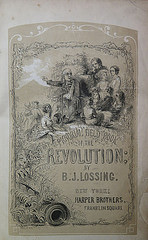
18762196843_f7ddb894da_mJesuit libraries abundantly reveal this double consciousness of nineteenth-century Roman Catholics. Their shelves are filled with works of European theology and philosophy. But the History and Literature sections had a strong number of imprints related to the United States. Over the next few days we will be highlighting some of these publications, works like Benson Lossing’s two-volume The Pictorial Field-Book of the Revolution; or, Illustrations, by Pen and Pencil, of the History, Biography, Scenery, Relics, and Traditions of the War for Independence (1855) and James Parton’s Life of Andrew Jackson (1860). Through these works, students at St Ignatius College learned about what it meant to be an American citizen. How they negotiated and ultimately reconciled these competing demands likely varied from person to person, but helpfully reminds us of the complex position in which they found themselves.

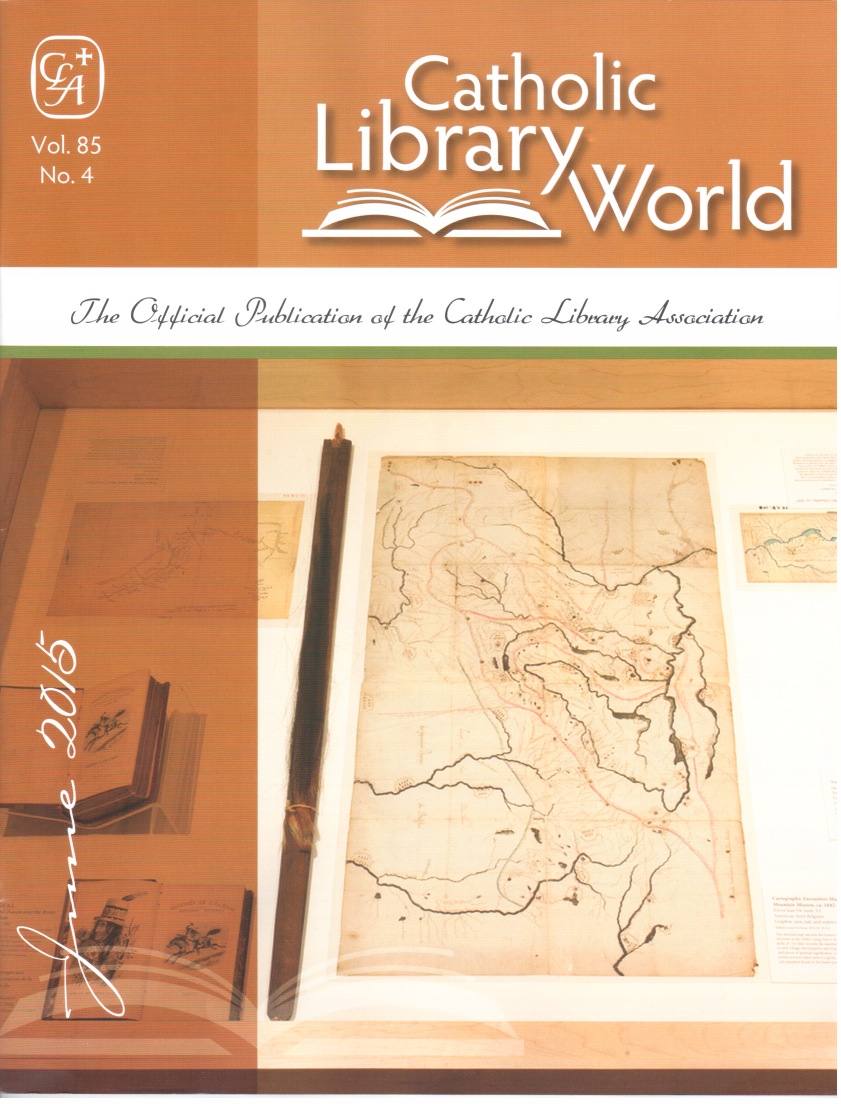
Check out the June 2015 issue of Catholic Library World

CLW June 2015 coverWant to learn more about the Jesuit Libraries Provenance Project in particular and the digital future of Jesuit Studies in general?  Check out the June 2015 (Vol 85, No 4) issue of the Catholic Library World, the peer-reviewed journal of the Catholic Library Association.  In this issue there are six articles by Loyola faculty and students on the various digital projects launched in conjunction with the 2014 exhibition, Crossings and Dwellings: Restored Jesuits, Women Religious, American Experience, 1814-2014.  They tackle a range of different types of historical sources – maps, letters, books, and material artifacts — and use a range of open source digital platforms for making these objects and scholarship about them more accessible to scholarly and popular audiences.  Articles include:

  • Kyle Roberts, “Digital Future of Jesuit Studies”
  • Edward Englestad, “De Smet’s Map: How Digital Tools Unlocked a Hidden Story”
  • Michael Polowski, “Visualizing De Smet’s Correspondence”
  • Jessica Hagen, “Jesuit Libraries Project: Digital Approaches to Analyzing a Historical Library Catalog”
  • Evan Thompson, “Jesuit Libraries Provenance Project”
  • Hope Shannon, “New Media at the Museum”

Each author shares her or his experience with the opportunities and challenges of doing a digital project on a different type of analog historical source and some of the lessons learned.  You might find some inspiration to create your own project!

What Lies Inside

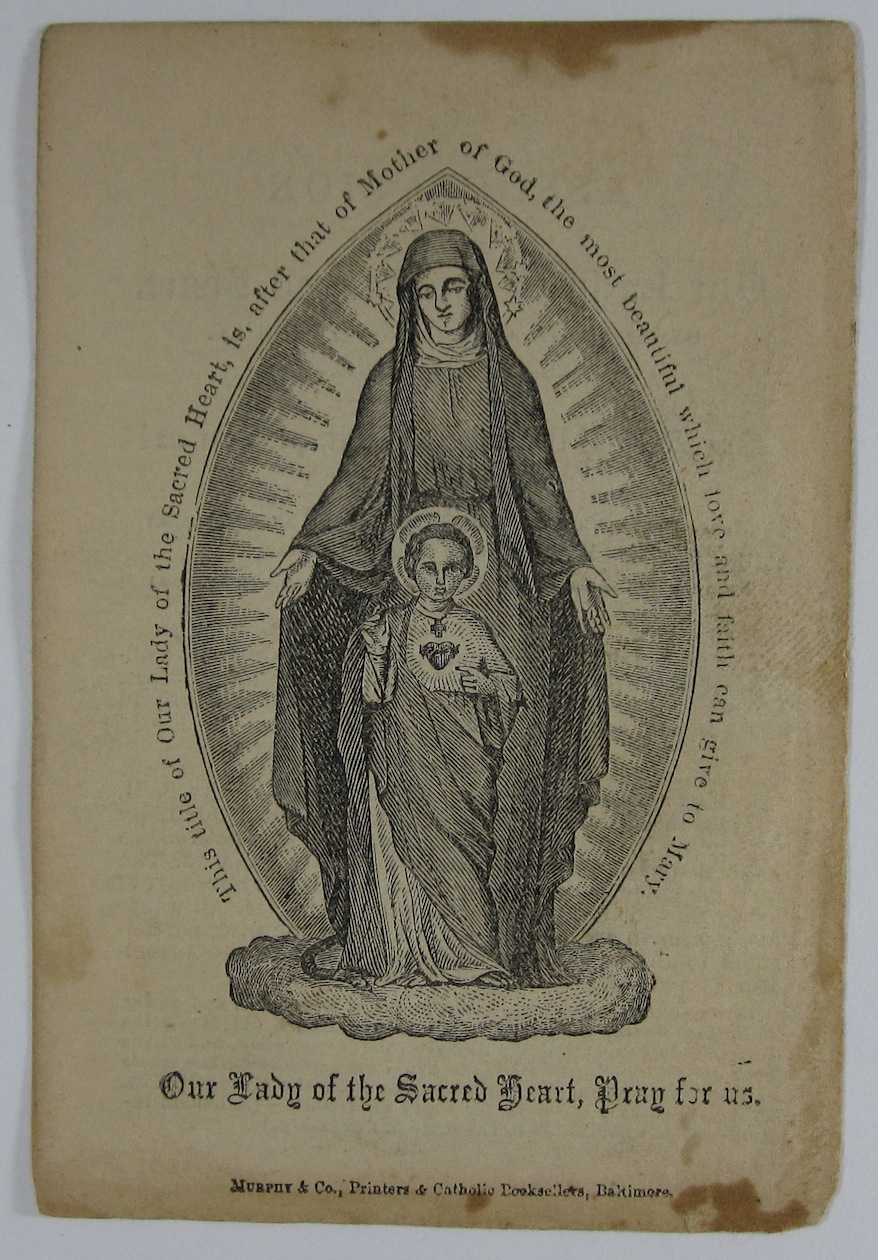
1867 Baltimore printed flyer for the Association in Honor of Our Lady of the Sacred Heart

1867 Baltimore printed flyer for the Association in Honor of Our Lady of the Sacred Heart. Source: Jesuit Archives: Central United States. Rare Book Collection, Bin A.

This June, part of the Jesuit Libraries Provenance Project team is researching in St. Louis at the Jesuit Archives, Central United States in search of clues about the origins of books in the c.1878 St Ignatius College Library.  The Missouri Province, whose records are in the Jesuit Archives, oversaw the Chicago Jesuits until their separation into a distinct province in the 1920s.

Many of the rare books that belonged to Jesuits in the St Louis-area houses and schools are now in the collections of St. Louis University.  There are, however, a small number of rare books that are still held by the Jesuit Archives.  Most of them relate directly to the rules and structure of the Society of Jesus.  Others belonged to specific Jesuits.

The things found tucked inside these books can be just as exciting as the books themselves.  Mid-nineteenth-century Catholic ephemera does not often survive.  Two fantastic pieces, however, have been found inside works in the Archives.  The first (above) is a small flyer for the Association in Honor of Our Lady of the Sacred Heart, a devotional society founded in Issoudun, France in 1854. The flyer was printed in Baltimore and is dated Christmas Day, 1867.  It was tucked inside an 1839 copy of the Rules of the Society of Jesus published in Washington, DC.  The other is a card with an image of St. Catherine.  The crude engraving of St Catherine, a popular Fourth-Century Saint, suggests an early date, while the orange-colored frame might have been designed to have a variety of different saints’ images inserted into it.  While it is easy to speculate that a Jesuit in Baltimore could have had the locally-printed Rules and Sacred Heart card, it is less clear from where the St. Catherine card came. It is tucked inside an undated reprint of the 1607 edition of the Rules of the Society of Jesus. The book does, however, have the embossed stamp of St. Stanislaus Seminary, which was the primary novitiate for the Missouri Province in the mid-nineteenth century and was located just outside St. Louis.

Printed card with image of St. Catherine. Undated, but likely mid-nineteenth century.

Printed card with image of St. Catherine. Undated, but likely mid-nineteenth century. Source: Jesuit Archives: Central United States. Rare Book Collection, Bin C. 

Have you found anything interesting tucked inside an old book? Share your experience in the comments!

Summer Reading I

The latest issue of the Journal of Jesuit Studies has arrived just in time for the end of the spring semester.  Aficionados of Jesuit print culture are in for a treat: the whole issue is dedicated to fascinating new scholarship on Jesuit libraries.  Editor Kathleen M. Comerford takes a global approach and has sought out articles on regions whose book and library culture have received less study over the past few decades: the Orinoco Delta, Japan, Ethiopia, Beirut, Canada, and Croatia.

Comerford identifies several overarching themes that tie the essays together, and which raise important questions about Jesuit libraries in other times and places.  First, she reminds us that libraries need to be considered first and foremost as a component of Jesuit missionary activity, providing materials that will be shared with their target audiences and which will also be resources (and relief!) for Jesuit missionaries.  Second, while the Constitutions of the Society often spell out the necessity of forming a library in a new field, they rarely specified which books had to be contained within it. As a result books in Jesuit libraries often comes from a variety of sources, by a range of means, and for a diversity of reasons.  Third, and only tantalizingly touched upon, is the way in which Jesuits confronted modernity and modernization through their libraries.  Finally, Comerford stresses the importance of placing Jesuit libraries, in particular, and print culture, in general, within the Society’s global context.

Three articles look at Jesuit missionary book culture in the sixteenth and seventeenth centuries.  The work of José del Rey Fajardo, SJ on seventeenth-century Jesuit missions to the Orinoco Delta reminds us of the preconditions — linguistic diversity, illiteracy — which needed to be addressed before a library could even be useful.  In Fajardo’s telling, the libraries in these regions were more of a resource for highly-trained European Jesuits who felt isolated in the field.  Yoshimi Orii explores the complex ways in which Jesuits translated European books for Japanese audiences.  Books can also become proxies for people and faith reveals Kristen Windmuller-Luna in a fascinating essay on Ethiopian missions.  There Jesuits encountered the exact opposite of the Orinoco Delta: a longstanding culture of the book.  But efforts to erase doctrinal error led Jesuits to efface beloved works of the Ethiopian Orthodoxy, only to find their own libraries – and even themselves — erased not long after.

Two articles situate Jesuit libraries in the twentieth century.  Through his study of the Oriental Library of the Université Saint-Joseph in Beirut, Rafael Herzstein reveals the way in which libraries were shaped in reflection to the context in which they were located.  His focus on scholarly magazines published under the aegis of the library remind us of the way in which writing, translating, and printing have long been part of the Jesuit missionary enterprise, even as their preferred formats have changed over time.  Gordon Rixon, SJ shows how the provenance of books collected from the relatively late library of Regis College in Toronto (founded 1930) illustrate the long history of Jesuit-Native American interaction, although he does not explicitly reveal if they were collected for that reason or (as it sounds) if the library collected everything that was sent to it from Canada’s Jesuit houses.  Intention and chance are opposing but omnipresent realities of library growth.  The real treasure in his essay is a fantastic reproduction, description, and analysis of a visual mnemonic for a pedagogical plan designed by Nicholas Point for one of the Native reductions in Canada.  It is a rich document that will be incorporated into my teaching this fall semester.

Finally, Marica Šapro-Ficović and Željko Vegh’s article on Croatian Jesuit libraries takes a longue durée approach, spanning the pre- and post-suppression order.  Particularly valuable in their account is the attention paid to the way in which Jesuits shaped their library collections in relation to local circumstances.   Rather than all having identical collections, Jesuits built libraries that responded to local needs and opportunities.

Check out this excellent new issue of the Journal and share with us what you’re looking forward to reading in the coming months!


Report from the road: New York City, 2015

A modern struggle for anyone in the humanities is  justifying the importance of their research. The rapid progress of the hard sciences has left fields like History in a precarious position. This comes from the (misguided) opinion that everything that can be known about the past has already been discovered and all other work in it is purely academic. Some would argue, History does not cure cancer, grow the economy, or build satellites. Short of discovering the lost city of Atlantis, History does not need more students.

During the annual conference for the American Historical Association (AHA) and American Catholic Historical Association (ACHA) this past January, this idea was shown to be simply wrong. Shortly after the start of the new year, the project team of Dr. Roberts, Evan, and Zac traveled to Times Square, New York City for AHA and ACHA’s annual conference. Hundreds of historians and people interested in history gathered together from around the world to share their work.

Some of those people came to our presentation on the Jesuit Libraries Provenance Project. The panel helped reinforce our confidence in the project’s legitimacy and importance to the field. In particular, legendary Jesuit historians John Padberg of Saint Louis University, and John O’Malley of Georgetown University offered praiseworthy comments and questions about collaboration with other like projects. While we have given this presentation previously, the opportunity to do so before such accomplished and decorated historians made it seem as though our project was contributing something very valuable to the larger historical community.

Much of our work requires long hours alone with original library books and computers. Often when we are collaborating with others, its through the means of social media. The conference provided an exciting opportunity to bring the fruits of our endeavors to the larger academic community on a personal level.

As we move towards finishing gathering and photographing the remainder of the original books from St Ignatius College, the experience of presenting our research in a global city surrounded by a community of scholars was gratifying — a much-welcomed bridge between us and the larger academic world.

– Zachary Davis and Evan Thompson, JLPP Intern

Confounding Crests

A year has passed since we began undertaking our detective work on the original books from the St Ignatius College library. Over that time we have been able to share some fascinating discoveries with you. In the third volume of Ranke’s Lives of the Popes we encountered an inscription from a Union soldier who decided to take some souvenirs from the home of a fleeing Confederate minister (and whose story we have been able to reconstruct thanks to the help of our readers!) In a 1471 edition of Pliny we discovered evidence of previous ownership by the Duke of Sussex, sixth son of George III, a collector and notorious spendthrift. Yet rarely have we written about our failures. Perhaps “failure” is too strong a word. Sometimes our efforts come up against dead ends, and there is little that can seemingly be done about it …

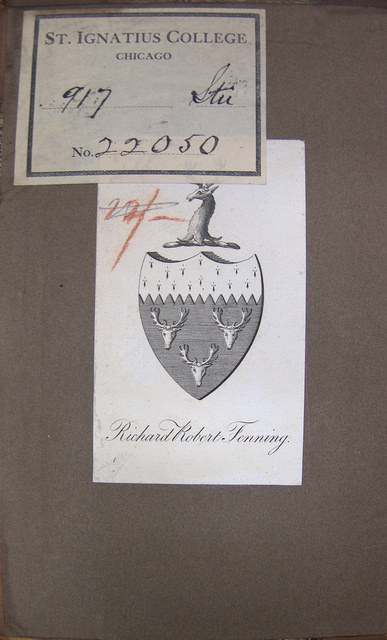
This was such a situation just this past month when I discovered this bookplate inside the cover of the first volume of James Stuart’s Three Years in North America (Edinburgh, 1833):

The bookplate that eludes identification!

The bookplate that eludes identification!

I decided the way to track down the previous owner might be through the heraldic crest.  After preliminary research, I thought it to be the crest of the Devonshire family from England as it matched one of their symbols. When I contacted the estate’s archivist, however, he confirmed for me that the bookplate did not belong to the Devonshire family. I spoke with him for a while and discovered that there were a hundred ways to decide whether a crest did not belong to a family, but there are very few ways to confirm who it does belong to. These crests can differ in very subtle ways such as the positioning of the animals, the number of antlers, and a thousand other ways. With the number of royal families, they would run out of the noble animals pretty fast if they were unable to differentiate in that way. I suppose this is why very few families adopt a gopher as their symbol.

After further research, I found that anyone could have put this crest into our book as the U.S. did not care to police the use of family crests or symbols. Anyone could have adopted these three stags as their personal symbol when they owned the book. Ultimately, I spent a good ten hours with this book, and came up with few results. The experience, though, was still important. I found out more than I could ever need to know concerning family crests and learned something new about the history of families in the U.S. So even though the search itself was fruitless, that does not mean it was worthless.

– Evan Thompson, JLPP Intern

The Roots and Routes of a Science Textbook

The Italian Peninsula in the eighteenth century was the staging ground for countless wars and revolutions.  The Empires of Spain, Austria, and France, not to mention countless Italian factions, spilled blood over one of the smallest strips of land in Europe.  The city of Rome, and all of its inhabitants, witnessed much of this slaughter. One of the books in the library of St. Ignatius was more than just a witness, it was a likely victim.

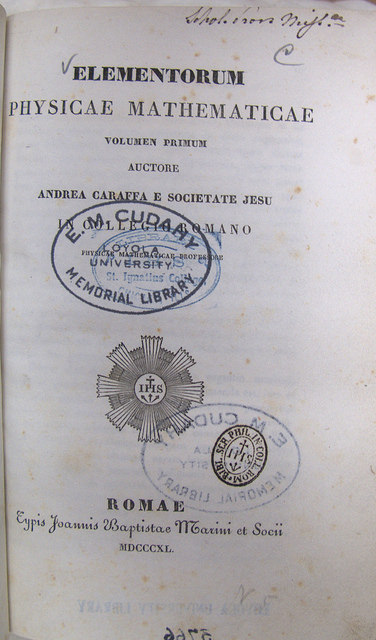
Andrea Caraffe's Elementa Physicae Mathematicae (1840) in the St. Ignatius College Collection

Andrea Caraffa’s Elementorum Physicae Mathematicae (1840) in the St. Ignatius College Collection


Caraffa’s Elementorum Physicae Mathematicaefound its way from the Eternal City to Chicago in the short 30 years between the book’s publication and when the Saint Ignatius College Library was founded. During that time, the city of Rome was subject to numerous uprisings and suppressions. The Roman Republic, a rebellion against the Papal Monarchy with connections to other rebel movements in Venice and Milan, was formed in 1848 under the guidance of Garibaldi and Mazzini, two Italian nationalists and republicans who would be instrumental in Italy’s later unification. The revolution was soon suppressed by French forces who retook the city of Rome and returned it to the fled Pope Pius IX. For the next twenty years the Pope would be under French protection until the retaking of the city by King Victor Emmanuel II during the unification of Italy.

Stamp of the Collegio Romano indicates its ownership before coming to St. Ignatius College.

Stamp of the Collegio Romano indicates its ownership before coming to St. Ignatius College.

Any of these events could have led to the loss of the book from its place in an important Jesuit Library in Rome. A stamp on the title-page indicates that the book belonged to the Collegio Romano (College of Rome/ Roman College – today’s Pontifical Georgian University).  The Collegio Romano was founded by St. Ignatius of Loyola in 1551 as a “School of Grammar, Humanity, and Christian Doctrine” at the base of the Capitoline Hill.  Three hundred years later, the Collegio Romano had an important library on a variety of subjects but had also witnessed its share of persecution, having been closed with the Suppression in 1773 and not restored to the Jesuits until 1824. During the revolution of the Roman Republic, the Jesuits were expelled from the city again by the new government.

How this book made its way to North America amidst the violence of mid-century uprisings is unclear. Perhaps French troops removed it and it was sold in Paris. Or maybe a fleeing priest took the book with him when the revolution was threatening the stability of the city.  Somehow it made its way either to London, Paris, or perhaps even one of the Italian port cities like Genoa where books were easily bought and sold.

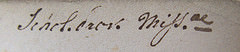
Ownership mark of the Missouri Province, post 1863

Ownership mark of the Missouri Province, post 1863

Yet sometime during or after 1863, this book had made its way into the hands of the Jesuits at the Scholasticate of the Province of Missouri (Schol. Prov. Miss.ae) which was located at Florissant.  How this book (and hundreds of others) made their way north to Chicago is also imperfectly understood, but will be a focus of research in the coming academic year.

From Rome to St Louis to Chicago — and to an unknown number of places in between — this copy of Caraffa’s Elementa Physicae Mathematicae has been a witness to violence and exile and now safely resides in Loyola’s Special Collections, waiting to tell its story!

Research by Evan Thompson, JLPP Intern, with valuable help from Doug Wayman and Stephen Schloesser, SJ.

Catch us on the Road!

From the Geological Survey of Illinois, Vol. 5 (1873) in the collection of the original St Ignatius College Library.

From the Geological Survey of Illinois, Vol. 5 (1873) in the collection of the original St Ignatius College Library.

Connecting with the Jesuit Libraries Provenance Project just got easier! In the next few months, team members from the Jesuit Libraries Provenance Project will present at conferences throughout the United States.

The talks begin here, in Chicago or the Third Coast, with Lunch & Learn: Fostering Engaged Learning with Museum and Archive Collections, a program for Loyola faculty on Thursday, O‌ctober 9th, 2014 11:30am – 1:00pm at the Loyola University Museum of Art (LUMA) Simpson Lecture Hall.  Danielle M. Forchette, M.Ed., Center for Experiential Learning, and Dr Kyle Roberts will explore how museum and archive collections can provide resources for engaged learning across the disciplines. Drawing from the Crossings and Dwellings exhibition, they will look at ways works of art and primary sources can provide inspiration and fresh points of entry into the reflection activities that are critical for the student’s engaged learning experience.

Evan Thompson’s will discuss the Jesuit Libraries Provenance Project as part of a larger panel on the “Digital Future of Jesuit Studies” at the conference Crossings and Dwellings: Restored Jesuits, Women Religious, American Experience, 1814-2014 in Chicago on Loyola’s Water Tower Campus on Saturday, October 18th, at 11:45 am.  The conference closes the exhibition of the same name on display at LUMA, Loyola’s Museum of Art, which has a gallery devoted to the work of Loyola students reconstructing Loyola’s original library catalogue.

Project Director, Dr. Kyle Roberts will be presenting at the Newberry Library on Wednesday, October 29 at 4 pm. Roberts’ talk “Historic Libraries as Sites for Teaching Digital History,” focuses on what he’s learned about teaching digital history through the reconstruction of the original St. Ignatius College library and digitally archiving the surviving books provenance information.

Next, in November, the project team travels to the East Coast to present at Bucknell University’s Digital Scholarship Conference, titled, “Collaborating Digitally: Engaging Students in Faculty Research.” Roberts and Thompson present on Sunday, November 16 at the “Old Records, New Questions, New Collaborations” session. Their paper “Analog Library Books and Digital Scholarly Collaboration,” promises to close the three-day conference well, simultaneously showcasing new opportunities for collaboration and raising questions about the processes.

Roberts then goes to the West Coast for the American Academy of Religion’s Annual Meeting in San Diego. He presents on the “New Media, New Audiences: Making the Study of Religion Online” panel the first day, November 22. Together with Sally M. Promey, R. Marie Griffith, Nausheen Husain, and Hussein Rashid, the panel focuses on how born digital projects intended for wide audiences fit into the tradition and established modes of scholarship in the academy.

The team returns to the East Coast in January to present at the American Society of Church Historians and American Catholic Historical Association meeting in New York City on January 3. Here, Roberts and Thompson will discuss digital approaches to nineteenth-century Catholic print culture.

Although we’d greatly appreciate meeting you in person, there are ways to remain digitally connected to the project as Roberts and Thompson travel from coast to coast. Follow up with them in upcoming blog posts and look out for live tweets from the conferences!

Mühlbauer & Behrle: Importers, Booksellers, and Stationers

The provenance material that we have been collecting over the past few months from Loyola’s original library books has come from all points in the lifespan of the surviving books.  Some tell us about original owners, like seventeenth-century monasteries, while others get us closer but not quite to the founding of St Ignatius College.  Last week’s research brought to our attention a bookplate that places us right in the period when St. Ignatius was collecting in the 1870s.  Researching this work reveals a story that includes two enterprising German businessmen, the Great Chicago Fire, a rare title, and a tragic loss.

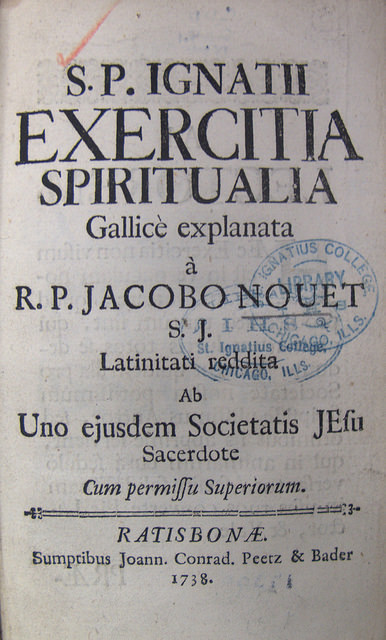
The bookplate is pasted on the inside front cover of Loyola’s edition of the Spiritual Exercises from 1738 (now in the collections of Loyola’s Special Collections and University Archives):

our starting point

The bookplate and it’s placement in an eighteeth-century edition of the Spiritual Exercises raises interesting questions.  First, who were Mühlbauer & Behrle?  How did they get in to the book selling business? Were they successful at what they did? Did they deal in antique books? rebind old books? or some combination thereof? Luckily, this pair left a trail in the history of the Chicago book selling business.

According to Alfred T Andreas’ History of Chicago Vol 3 (1886), Mühlbauer and Behrle began their business in July 1870 at No. 147 North Clark Street.  They lost their stock, worth $10,000 in the 1871 Great Chicago Fire.  According to Andreas, they only realized $350 on their insurance policy of $5200.  “Their creditors not only extended the time for payment of old debts, but sent word to them to order all the goods they wanted and to take all the time they needed for payment. By the leniency of their creditors, they have always paid one hundred cents on the dollar.”   Mühlbauer and Behrle rebuilt their company at No. 311 West Twelfth Street, which would have been right down the street from St Ignatius College.  In the spring of 1874 they moved to a new location at No. 41 LaSalle Street.  Perhaps this book came into the collection of St Ignatius between the fall of 1871 and the spring of 1874.

Andreas includes more information about the principals in the firm:

“Aloys Muehlbauer, the senior member of this firm, was born in Bavaria, Germany, on April 15, 1841. Finishing his education, when sixteen years of age, at one of the gymnasium schools near his birthplace, he became an employee with Fred Pustet, Ratisbon, Bavaria, and other book firms in Bavaria and Austria, and then with Benziger Bros., a Catholic book and church-goods house, whose headquarters are at Einsiedelen, Switzerland. With this firm he remained nearly four years. They have branch houses in New York, Cincinnati and St. Louis. He came to America in 1867, going to Cincinnati as an employee of the old firm in Switzerland. There he remained until 1870, when he came to Chicago in company with Raymond Behrle, his present partner …

“Raymond Behrle was born at Cincinnati, Ohio, on November 25, 1836. His parents, natives of Baden, Germany, immigrated to this country in 1830, and settled at Cincinnati in 1831. He received his education in the parochial school of St. Mary’s Church, Cincinnati, and in 1850 commenced work for Kreuzburg & Nurre, a book firm, continuing with them until 1860. At this time he made an engagement with Benziger Brothers, successors to Kreuzburg & Nurre, remaining with them until 1870, when he formed a partnership with his present partner…”

Once they settled into their post-fire operation, they were well-known for their selection.  “Here may be seen as complete a stock of books as is to be found in the city, comprising the leading standard works of fiction, history, biography, science, theology, prose and poetry, many of the editions being imported, and most of them printed in the German language. The firm also publish and deal in all kinds of church goods. They have achieved a more than local reputation, and are in constant receipt of orders from all quarters of the United States. Every effort is made on the part of the able and painstaking proprietors to cater to the most elevated and refined intellectual taste. ranging from fiction to history to prose and theology… (Origin, growth, and usefulness of the Chicago Board of Trade, 1885, p.359). Mühlbauer and Behrle were also listed in an edition of Publishers Weekly under “German Bookstores” which stated that they were known for selling “a full line of church goods, from vestments, chalices, lamps, candlesticks, statues…”  This pair of German businessmen thrived in their enterprise. According to Publishers Weekly the pair recorded annual sales of $50,000, which adjusted for inflation comes out to over $890,000.

The sources from the 1880s establish that the firm was selling contemporary German publications.  But is this 1738 Spiritual Exercises an indication that they also dealt in antique books?  Or were they simply rebinding books for customers? Answering this question is a little bit more tricky…
14647384284_ccefaab7a6_z

Click on the image to see the book on our Flickr site.

A 1891 edition of The Directory of Second-Hand Book Sellers provides evidence that Mühlbauer & Behrle sold used books.  More evidence that Mühlbauer & Behrle sold used and rare books shows up again in a recent listing in the Philadelphia Rare Books and Manuscripts Company for a 1583 edition of Pietro Galatino’s De arcanis Catholicae veritatis… in original condition and with a book plate from Mühlbauer & Behrle.

There is one more piece of the puzzle:  Behrle married Christina Ellick in 1860 and had five children.  Alexander J, the oldest, attended St Ignatius College for three academic years, between 1873 and 1876, studying Third, Second, and First Humanities, the equivalent to today’s High School part of the curriculum. His younger brother Louis Frederick followed in his footsteps and began the Third Humanities program in the Fall of 1876, but soon after died at the age of sixteen. (Source: St Ignatius College Course Catalogues).

Whether Mühlbauer & Behrle acquired (probably from Europe) and sold the book to St Ignatius, simply rebound the book for them, or perhaps gave it in memory of Louis Frederick Behrle requires more research.  The book itself is quite rare.  Worldcat only lists six known copies, of which Loyola owns the only one in the United States.  Given the importance of the Spiritual Exercises to the Jesuits, we can only begin to imagine the range of ways and reasons this book made its way to the St Ignatius College Library.

If anyone has information to share on Mühlbauer & Behrle, on this edition of the Spiritual Exercises, or anything else that might be useful, please do in the comments below!

– Jim Naughton, Intern


Head West, Young Man

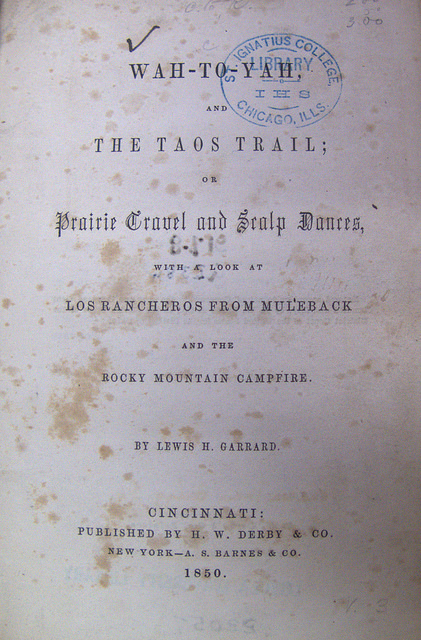
This week of photographing books in Loyola’s Special Collections and Rare Books brought a title and a genre to mind that piqued my interest. Wah-to-Yah, and the Taos Trail; or Prairie Travel and Scalp Dances, with a Look at Los Rancheros from Muleback and the Rocky Mountain Campfire is by Lewis Hector Garrard. The genre according to Loyola libraries’ Pegasus site for the book is description-travel and the story the author tells is certainly one of being away from home and partaking in dangerous adventures.

a first edition!

a first edition!

It may helpful to know a little bit about the author.  According to the finding aid for the authors’s papers at Minnesota State University Mankato, Lewis Hector Garrard embarked on his voyage when he was seventeen years old and traveled through the Southern Rocky Mountains, which encompassed New Mexico and the state’s Taos areas. Following his trip, Lewis Garrard published Wah-to-Yah, and the Taos Trail in 1850 and later went on to medical school at the University of Pennsylvania. Dr. Garrard lived out most of his days in Minnesota serving in various political offices and eventually passing away in 1887 in Lakewood, New York. This raises the question: what did this man have to contribute to Native American history and how common was this type of narrative at the time?

According to a summary on Amazon.comWah-to-Yah follows the adventures of a young man who traveled with the famous trader Céran St. Vrain on a caravan heading to Fort William. Mr. Garrard spends a good deal of time at the fort and later with a group of Cheyenne Indians before joining a band of volunteers to avenge the death of Governor Charles Bent of Taos. Throughout his work, Mr. Garrard talks about notable figures such as Kit Carson and John L. Hatcher during such an interesting time as the Taos Revolt and Mexican-American War. However, even with such an interesting narrative taking place, it is not hard to see why this title may have lost some of its popularity.

According to the Indiana University-Bloomington Libraries site, the author of the Encyclopedia of Exploration, 1800-1850: A Comprehensive Reference Guide to the History and Literature of Exploration, Travel, and Colonization between the years 1800 and 1850, Raymond John Howgego, stated that there may have been more travel narratives written between 1800-1850 than all preceding years. Travel literature is an interesting genre because it attempts to transport the reader to a place where they can visualize the landscape, experience the culture of a particular people or imagine the taste of a certain population’s cuisine. Personally, I feel as though this genre has been dwindling and I could not name one modern day travel novel.

This brings up one last and more direct question: Why would St. Ignatius College bother having a copy of Wah-to-Yah in their library? Some possible answers to why St. Ignatius may own a copy include: The readership during the 1870’s and onward had an interest in the travel genre. Someone may have donated or gifted the book from their own personal library. Perhaps, it was pure coincidence that the book ended up here at all. Regardless of what conclusion one might come to it certainly is food for thought about how the readership and interest of library goers chances over time. What do you think the next big trend will be?

Intrigued?  Read the full text of Wah-To-Yah for free on Google Books or Hathitrust.

Jim Naughton, JLPP Intern